
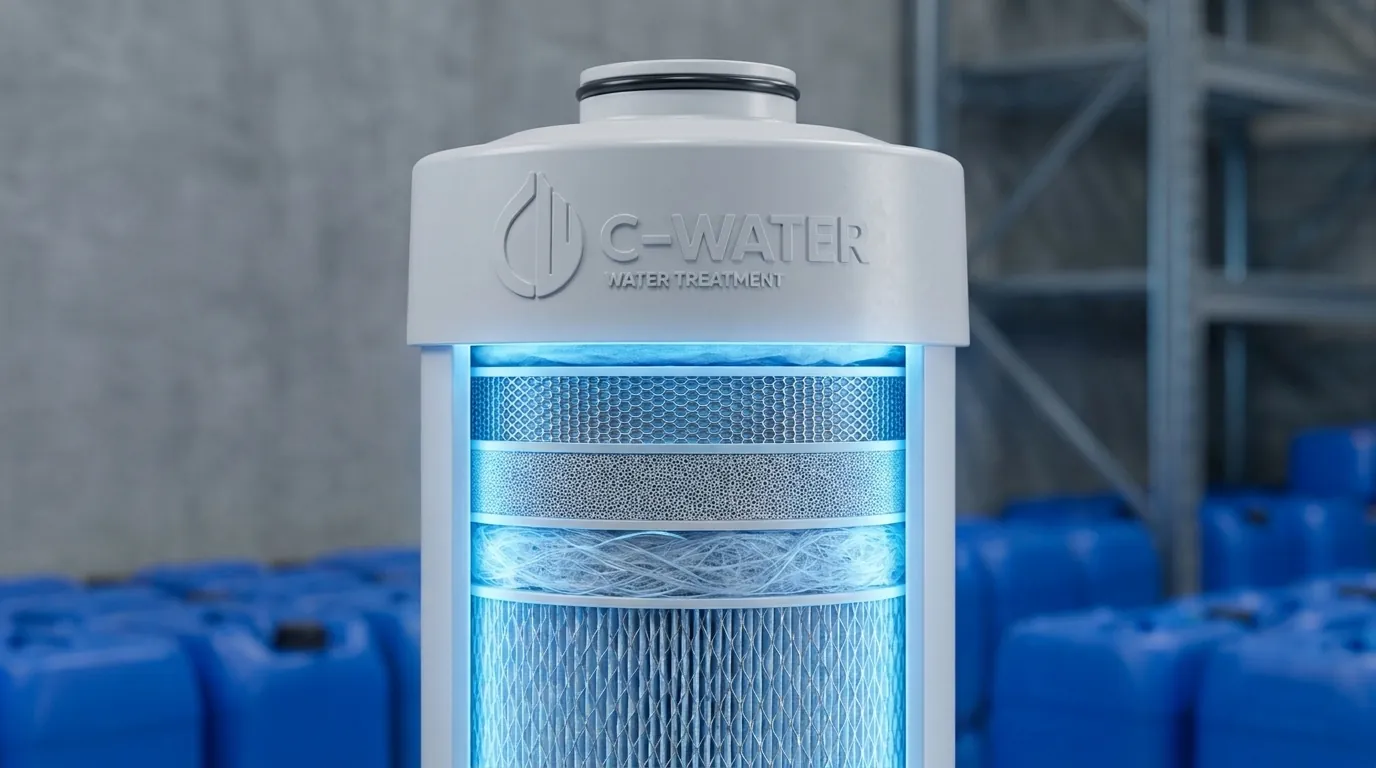
Filtration
Filtration Engineered Around the Application.
Filtration is rarely the point of a water system, but it decides how well the rest of it works. Every heat exchanger, nozzle, membrane and instrument downstream is protected — or not — by the decision made here.
01What It Solves
The Problem It Addresses.
Suspended solids do three things: they foul heat-transfer surfaces, they shelter microbiological growth, and they consume treatment chemical that should have been protecting metal. Removing them at the right degree reduces all three loads at once.
02How It Works
How It Actually Works.
- 01
Filtration degree
The retained particle size is set by what has to be protected, not by what is convenient. Over-filtering raises differential pressure, cleaning frequency and energy cost; under-filtering passes the problem downstream.
- 02
Self-cleaning cycles
Automatic filters clear the element on differential pressure, elapsed time or manual command, usually without interrupting the main flow. Cleaning frequency is a direct readout of the actual solids load.
- 03
Where it sits
Full-flow filtration treats everything passing a point. Side-stream filtration treats a fraction of a recirculating volume continuously, which is often the more economical answer for a cooling tower basin.
- 04
Solids load, not pipe size
Sizing follows the mass of solids arriving per hour and the nature of those solids — sand behaves differently from biological floc or corrosion product. Pipe diameter tells you almost nothing about that.
03Applications
Where It Is Used.
- Cooling tower side-stream filtration
- RO and membrane pretreatment
- Process water polishing
- Irrigation network protection
- Produced and injection water
- Wastewater and recovery duty
04Technology Partner
TIMEX
C-Water sizes the filter to measured solids load, flow and operating pressure — not to nominal pipe size. Selecting the wrong filtration degree is one of the most common and most expensive errors in industrial water systems.
Explore the partnershipRelated Solutions
Related Products
Related Services
Related Knowledge
Is this the right technology for your system?
That question is answered by the water analysis and the operating conditions, not by a catalogue. Start there.