
Solution
Keep Heat Transfer Working at Its Best.
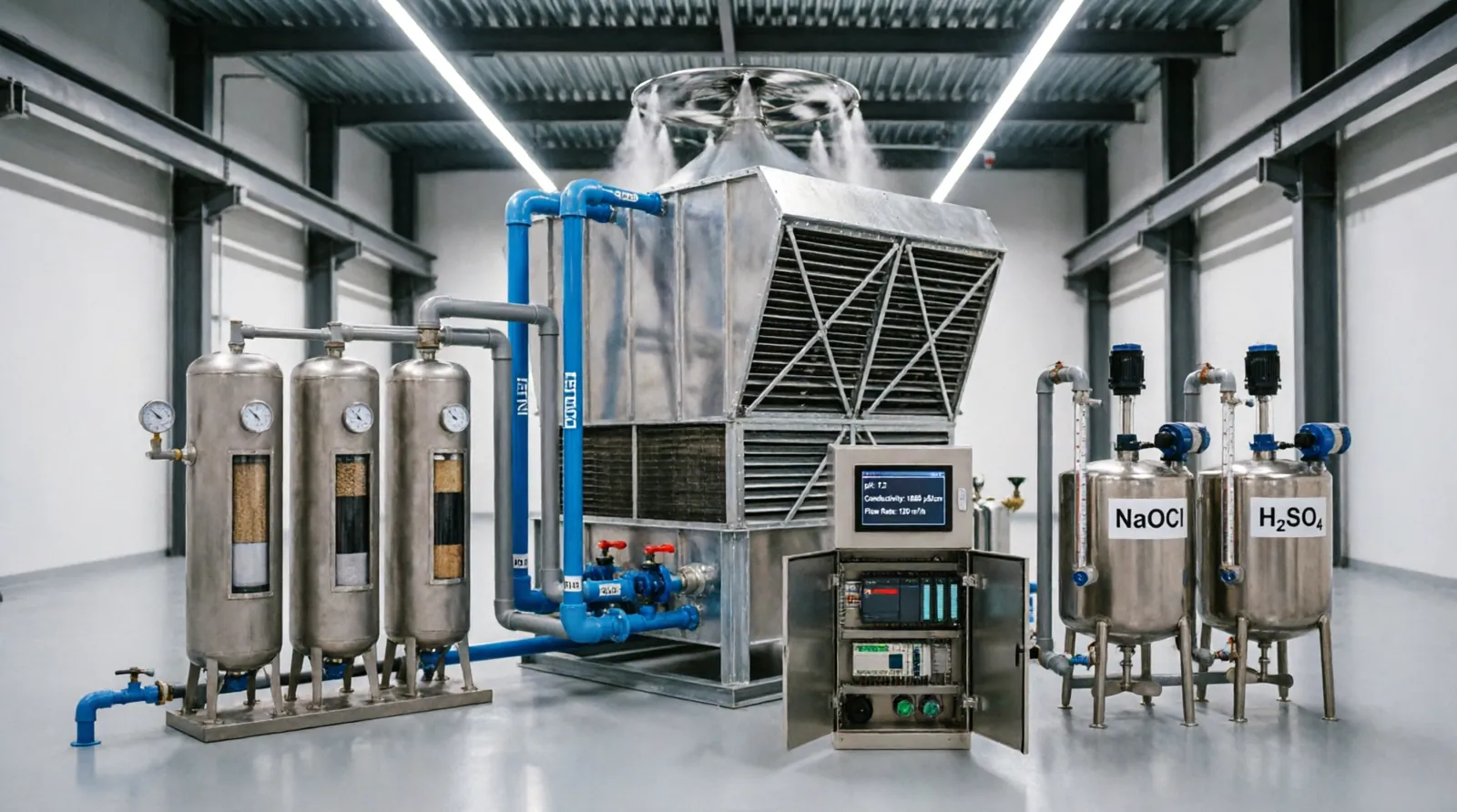
Cooling systems are designed to move heat — not scale, corrosion, deposits and microbiological growth. C-Water brings treatment chemistry, filtration, monitoring, dosing and control together around the full cooling-water system.
01Why It Matters
Cooling Water
An open recirculating cooling system concentrates everything it does not evaporate. Dissolved solids build up, temperature and residence time favour biological growth, and the surfaces that matter most — the hottest ones — are exactly where deposits form first. A millimetre of scale on a condenser tube can measurably raise the energy required to reject the same heat, and the plant usually feels it as a compressor working harder long before anyone opens the exchanger.
02Common Problems
What Goes Wrong.
Scale
Calcium carbonate and other sparingly soluble salts deposit on the hottest surfaces as the water concentrates. Heat transfer falls, approach temperature rises and energy consumption follows.
Corrosion
Dissolved oxygen, chloride, low pH and mixed metallurgy all drive metal loss. Under-deposit corrosion is the most damaging form because it is localised, hidden and progressive.
Microbiological growth
Warm, aerated, nutrient-bearing water is an ideal culture medium. Biofilm insulates heat-transfer surfaces, shelters corrosion beneath it and is far harder to remove than to prevent.
Poor filtration
A tower is an efficient air scrubber. Airborne dust and debris collect in the basin, settle in low-velocity areas and consume treatment chemical that should have been protecting metal.
Uncontrolled chemistry
Dosing by timer assumes constant load. When production, ambient conditions or make-up quality change, the programme is either overdosing or leaving the system unprotected.
Excessive blowdown
Running at unnecessarily low cycles of concentration wastes water, wastes the chemical dissolved in it, and wastes the energy that went into treating the make-up.
03Operational Risks
What It Costs the Operation.
Lost thermal efficiency
Deposits and biofilm both act as insulation exactly where the system can least afford it.
Shortened asset life
Localised corrosion can take an exchanger or a chiller out of service long before the rest of the plant is due for renewal.
Unplanned downtime
Cleaning a fouled condenser is a shutdown activity. It is almost always scheduled by the fouling, not by the plant.
Water and chemical waste
Poorly controlled cycles waste both at once, and the cost compounds across a cooling season.
04The C-Water Approach
How We Work the Problem.
- 01
Analyse
Make-up and system water are analysed and read against the metallurgy, temperatures and duty of the actual plant. This establishes the achievable cycles of concentration before any chemical is selected.
- 02
Filter
Side-stream filtration removes the settled and suspended load continuously, reducing the demand placed on the chemical programme and keeping low-velocity areas clean.
- 03
Treat
Inhibitor, dispersant and biocide chemistry is selected as one programme, so the components support rather than degrade each other.
- 04
Dose
Feed is driven by make-up volume, conductivity or ORP rather than by a timer, and verified so that a call for dose can be shown to have produced one.
- 05
Control
Blowdown follows measured conductivity, holding cycles at the highest value the water chemistry safely allows instead of a conservative fixed setting.
- 06
Optimise
Trend data, corrosion coupons and periodic analysis show whether the programme is still matched to the system as loads and seasons change.
05Technology Stack
The System, Stage by Stage.
Each stage changes what the next one has to deal with. This is the sequence C-Water engineers around.
- 01
Make-up Water
Enters the system
- 02
Side-stream Filtration
Solids removed
TIMEX - 03
Treatment Chemistry
Inhibitor and biocide
Kurita Europe - 04
Controlled Dosing
Feed on demand
Walchem - 05
pH · Conductivity · ORP
Continuous reading
Walchem - 06
Blowdown Control
Cycles held
Walchem - 07
Cooling Tower
Heat rejected
- 08
Optimisation
Programme reviewed
Technology Stack
Related Products
Related Services
Related Industries
Related Knowledge
Let’s Talk About Your System.
Tell us the operating conditions and what you are seeing. We will confirm the water chemistry before recommending anything.